
If a storm rolled through Hickory and you’re wondering whether hail damaged your roof, you’re not alone. A hail damage roof inspection is the only way to know for sure, because hail marks on shingles are often too subtle to spot from the yard. This guide covers the signs you can check safely from the ground, what an inspector looks at up on the roof, and what to do next.
Short answer: look for dented gutters, vents and siding from the ground, never climb up yourself, and have a pro inspect the roof. We offer free roof inspections in Hickory and across Western NC.
Table of Contents
Can You Tell if Hail Hit Your Roof From the Ground?
Sometimes, but not reliably. After a storm, you can look for clues you can see safely from the yard, and those clues can tell you it’s worth getting a closer look. They can’t tell you what shape the roof is in. A shingle roof can be bruised or cracked in ways that don’t show from the ground, and an ordinary-looking roof can still have problems you won’t spot from the driveway.
Please don’t climb up there to check. A wet roof, loose granules and a ladder are a bad mix. Walk the property, take photos from the ground, and let a professional do the roof work.
Ground-Level Signs of Hail Damage on a Roof
Hail hits everything outside the house, not just the shingles. Soft metal and painted surfaces often show it first, so start there:
- Dented gutters and downspouts. Look for small round dings along the gutter edge and on the downspout elbows.
- Dents in metal parts on the roof. Roof vents, box vents, chimney caps and flashing are soft metal. You can often see dents from the ground, or in a photo taken with a phone zoom.
- Damaged siding, window screens or trim. Cracked or pocked vinyl, torn screens and chipped paint tell you hail came in with some force at your address.
- Dents on the AC unit, grill cover or car. Soft aluminum fins and thin sheet metal show impact marks well.
- Granules in the downspout or gutter outlets. A pile of shingle granules at the bottom of a downspout can mean the shingle surface was knocked loose. Some granules wash off a roof as it ages too, so this is a reason to look closer, not proof.
- Ceiling stains after the storm. A fresh stain or drip means water is getting in. Call right away, whatever caused it.
None of these clues alone proves your roof was damaged, and having none of them doesn’t prove it wasn’t. They’re what makes a hail damage roof inspection worth scheduling.
What a Hail Damage Roof Inspection Checks
A real inspection means someone gets on the roof, looks at each slope up close, and documents what’s there. Here’s what we look at during a free roof inspection:
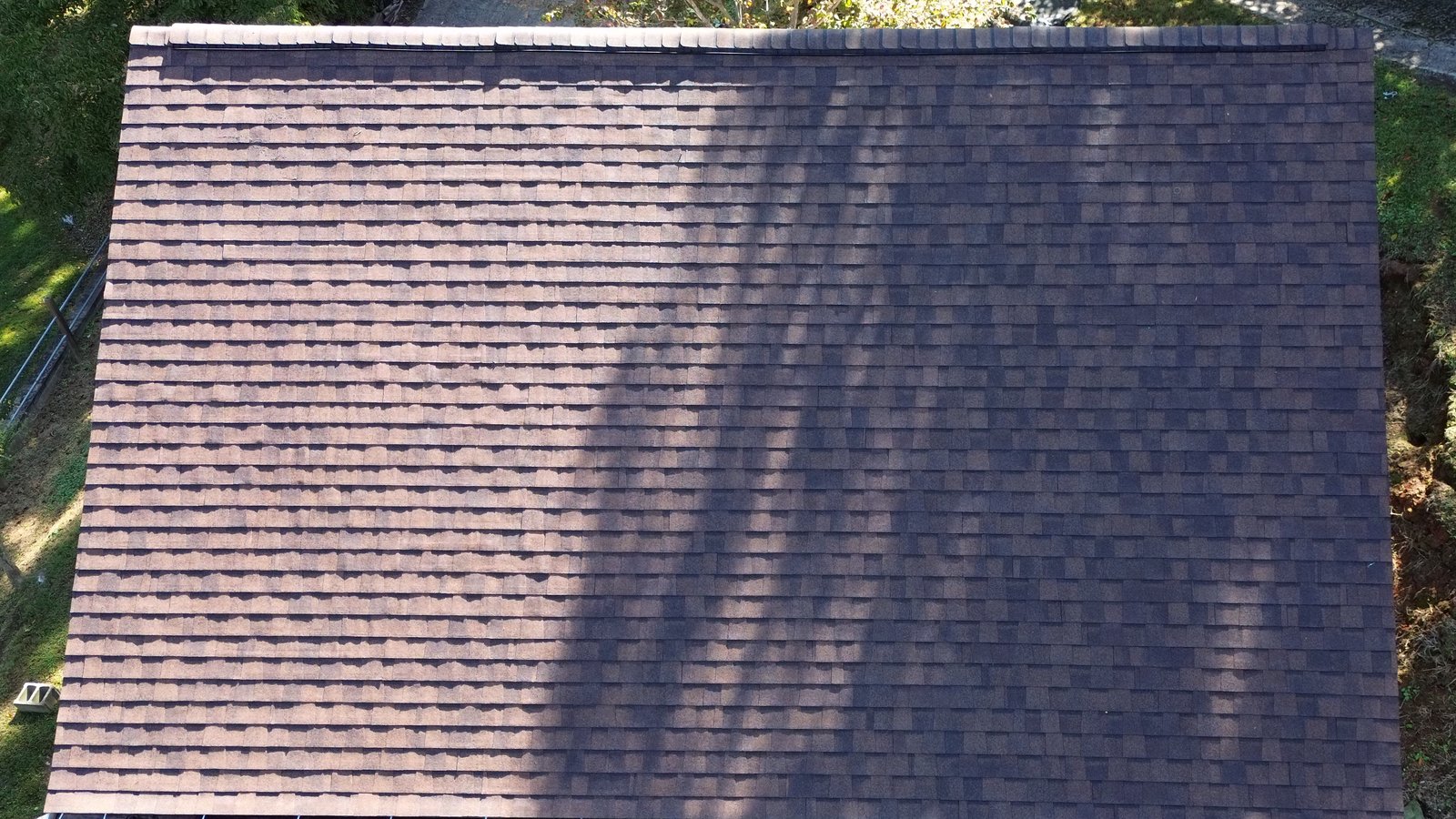
- Shingle surface. We look for bruises, spots where granules are knocked off, exposed mat, and cracks or fractures in the shingle. We check whether marks look like impact damage or like normal wear, blistering or foot traffic.
- Pattern across the roof. Hail tends to hit slopes that face the wind harder than the others, so we compare all slopes rather than judging from one spot.
- Soft metal. Vents, flashing, drip edge, valleys and chimney caps are checked for dents, which help show what size of hail came through.
- Ridge and hip caps. These get hit squarely and can crack or lose granules.
- Gutters, downspouts and siding. These help confirm what the storm did at your property, and they’re part of the story if you file a claim.
- Signs of leaks. We check the attic or ceilings if you’ve seen stains, and look at flashing and penetrations where water tends to enter.
- Age and overall condition. Older shingles can have wear that looks like hail, and we note what’s wear and what isn’t.
We take photos of everything, mark what we find, and tell you plainly what we see. If the answer is “nothing from this storm,” we’ll say that. If there is damage, you’ll have photos and notes in hand.
What Hail Damage Looks Like on Asphalt Shingles
Hail damage doesn’t look like a hole in the roof. On asphalt shingles, the signs are usually subtle:
- Bruises. A soft spot where the shingle mat was hit, sometimes felt more than seen.
- Bare or dark spots. Granules knocked off in a round or irregular pattern, exposing the asphalt underneath.
- Cracks or fractures. A break in the shingle where a stone hit, which can let water in over time.
- Random placement. Hail marks tend to be scattered across a slope with no pattern, unlike wear that follows the water’s path or foot traffic.
The hard part is that none of this is obvious in a photo from the street. That’s one reason we’re careful about how we talk about damage. We tell you what we see and show you the photos. Your insurance company decides what is covered.
How Big Does Hail Need to Be to Cause Damage?
There’s no single answer, and we’re not going to hand you a magic number. Hail size, wind, the age of the roof and the type of shingle all matter. For context, NOAA’s National Severe Storms Laboratory lists common comparisons: a penny is 3/4 inch, a quarter is 1 inch, a golf ball is 1 3/4 inches. It also says hail quarter size or larger is considered severe. You can read more in NSSL’s hail basics guide. The same page notes that if surface winds are strong enough, hail can fall at an angle or even nearly sideways, which is one reason one side of a house can look worse than another.
The Insurance Institute for Business & Home Safety (IBHS) runs ongoing hail research, including lab testing of how roofing materials hold up to hail impacts and how roof age affects performance. The takeaway for a homeowner: a roof’s age and material matter, so don’t assume that small hail can’t hurt an older roof, or that big hail always wrecks a newer one. Get it looked at.
A Recent Hail Report Close to Home
Hail near Hickory isn’t a once-in-a-decade thing. On August 11, 2026, a trained spotter reported half-dollar size hail on Blowing Rock Road near Patterson in Caldwell County. The National Weather Service logged it as 1.25-inch hail at 2:40 p.m. Eastern in the Storm Prediction Center’s reports, and the NCEI Storm Events record lists it a few minutes later, about 2:43 p.m. on the clock that day. On July 28, 2026, public reports of golf ball and half-dollar size hail came in from parts of Iredell and Alexander counties.
Those are reports from a spotter or the public, and they are preliminary. They tell you hail was reported in an area on a certain day, not what happened at your house. For how to look up your own date, see our guide to finding the storm date for a roof insurance claim, and the Storm Prediction Center daily reports.
What to Do if You Think Hail Hit Your Roof
- Write down the date. Even a rough date helps. Dated photos, phone alerts and weather reports can narrow it down.
- Take photos from the ground. Photograph dented gutters, vents, siding and anything else you can see safely, before any temporary repair.
- Stop active leaks. If water is coming in, call 828-501-0742. Our emergency roof repairs crew can help protect the inside of your house.
- Get a free inspection. A free roof inspection in Hickory documents the actual condition of the roof.
- Call your insurance company or agent. NCDOI’s guidance on windstorm and hail claims says to contact your homeowners agent or company to report the loss, and not to make permanent repairs until your insurance company has had a chance to inspect. Your insurance company decides coverage, so ask your agent about deadlines and your deductible.
Some NC policies handle wind and hail differently from other damage, with a separate or percentage deductible. Our post on the wind and hail deductible in NC explains the basics, and our guide to how a roof insurance claim works in North Carolina covers the process. We can’t read or interpret your policy for you, so check with your agent for the details.
Watch Out for Door-Knockers After a Hail Storm
After a big storm, out-of-town crews sometimes go door to door saying they found hail damage on your roof. Some are legitimate. Some aren’t local and can be hard to reach when you need a warranty call. Before you let anyone on your roof, ask for their local address, license and insurance information, and get a written inspection report with photos. Our post on spotting storm chaser roofers has the red flags to look for. You can also read our storm damage roof repair page to see how we handle repairs after a storm.
What Happens if the Inspection Finds Hail Damage
Then you have choices, and you don’t have to rush. If the damage is limited, a roof repair may be all the roof needs. If it’s widespread, you may be looking at a replacement. If you’re filing a claim, our insurance restoration team can walk you through our part of the process, with photos and documentation, while your insurance company handles coverage decisions.
Get a Free Roof Inspection in Hickory and Western NC
We offer free roof inspections in Hickory and across Western North Carolina, including Newton, Conover, Morganton, Lenoir and Statesville. We’ll check the roof, take photos and give you a straight answer, whether the answer is no damage, a small repair or something bigger.
If you’re planning ahead, get a starting number with our instant roof quote. Financing is offered through Hearth, a third-party platform. Learn about roof financing. Iconic Roofing is not a lender and is not Hearth; loans come from Hearth’s lending partners, and approval, rates and terms are set by the lender. Call 828-501-0742 to book your free inspection.
FAQ: Hail Damage Roof Inspections in Hickory
How do I know if hail damaged my roof?
Check from the ground for dented gutters, downspouts, vents and siding, then get the roof inspected up close. Shingle bruises, bare spots and cracks usually can’t be confirmed from the ground. Iconic Roofing offers free roof inspections in Hickory, NC. Call 828-501-0742.
What does a hail damage roof inspection include?
The inspector looks at each roof slope for bruised, cracked or bare shingles, checks soft metal like vents and flashing for dents, and looks at gutters, siding and signs of leaks. We take photos and explain what we find.
Should I get on my roof to check for hail damage?
No. Stay off the roof. Look from the ground, take photos and let a professional handle the inspection.
Does hail damage always mean I need a new roof?
No. Depending on what the inspection finds, the answer may be nothing, a repair or a replacement. Your insurance company decides what is covered, so ask your agent.
Should I call my insurance company before or after the inspection?
NCDOI says to contact your homeowners agent or company to report a wind or hail loss and to avoid permanent repairs until your insurer has had a chance to inspect. Ask your agent about deadlines and your deductible.