
How does a wind and hail deductible work on a North Carolina homeowners policy? In short, it is the amount you may pay out of pocket when a wind or hail claim is approved. Understanding your wind and hail deductible NC terms before the next storm hits can save you from a costly surprise. The details sit on your policy’s declarations page, and they can differ a lot from a standard deductible.
This guide walks through what a wind and hail deductible NC homeowners may see, how named storm deductibles work, and what the NC Department of Insurance says to do after damage. We’re a roofing company, not an insurance company. We can’t interpret your policy or promise any claim outcome. Your agent and your insurance company have the final word. We can help you document roof damage with clear photos and a free inspection.
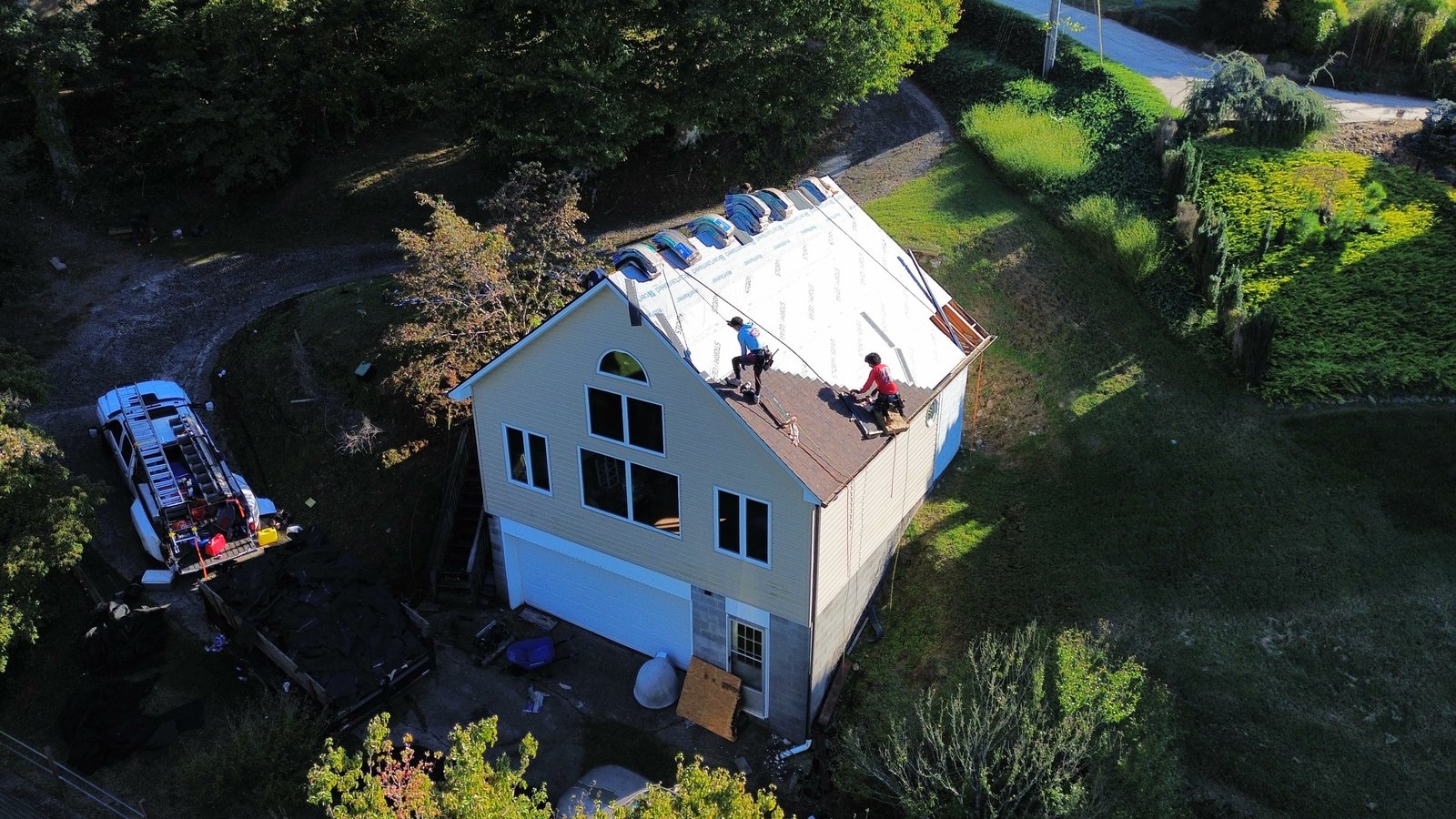
What Is a Wind and Hail Deductible NC Homeowners Should Know?
A deductible is the part of a covered loss you pay yourself. Many North Carolina policies treat wind and hail differently from other losses. According to the NC Department of Insurance (NCDOI), some policies use a percentage deductible for windstorm or hail instead of a flat dollar amount. That percentage is usually based on Coverage A (Dwelling) and is shown on your declarations page.
NCDOI gives a clear example. If your home is insured for $200,000 and you have a 1% windstorm or hail deductible, you would pay $2,000 out of pocket for every wind or hail related claim. That is separate from how other claim types may work on the same policy. Always check your own declarations page. Do not assume your neighbor’s deductible matches yours.
For homeowners in Hickory and across Western North Carolina, storm season is when this number matters most. Wind and hail can strip shingles, dent metal, and open the door to leaks. Knowing your wind and hail deductible NC figure ahead of time helps you plan if damage occurs.
Named Storm Deductible vs. Windstorm or Hail Deductible
NCDOI describes two common percentage deductibles that can show up on North Carolina policies. They are not the same thing.
Windstorm or Hail Percentage Deductible
This is a percentage of Coverage A (Dwelling). It can apply to wind or hail claims as your policy defines them. As in NCDOI’s example above, 1% of $200,000 in Coverage A equals a $2,000 deductible for every wind or hail related claim. The exact percentage and when it applies are set by your insurer and listed on your declarations page.
Named Storm Deductible
NCDOI defines a “named storm” as a weather-related wind event that is formally named by the National Hurricane Center, National Weather Service, World Meteorological Organization, or a similar body. That includes hurricanes, tropical depressions, and tropical storms. A named storm deductible is typically a percentage of Coverage A (Dwelling) or Coverage C (Personal Property). It is also shown on the declarations page.
NCDOI says the named storm deductible period begins when an advisory, watch, or warning for a named storm is issued for any part of North Carolina by the National Weather Service. It ends 24 hours after the last watch or warning, or the last advisory, whichever is later. NCDOI’s example: a 2% named storm deductible on a home insured for $300,000 equals $6,000 out of pocket.
Western NC gets fewer named storms than the coast, but leftover tropical systems and severe thunderstorms still bring damaging wind and hail inland. Read your declarations page so you know which deductible applies to which kind of storm.
When Windstorm and Hail Coverage Is Separate
Depending on location and underwriting, windstorm and hail coverage may be excluded from the primary residential policy. NCDOI notes that some owners then buy a separate windstorm and hail policy with a separate deductible.
Separate wind policies are often written by the North Carolina Insurance Underwriting Association (NCIUA), also called the Coastal Property Insurance Pool, for Beach and Coastal Areas. Eligibility for that separate policy requires an active primary policy from an admitted carrier that excluded windstorm. Even with a separate NCIUA wind policy, NCDOI says the primary insurer still investigates and adjusts the claim.
Most inland homes in the Hickory area keep wind and hail on the primary policy. Still, exclusions and separate policies do exist in North Carolina. If your declarations page or renewal notice mentions a windstorm exclusion, ask your agent what that means for you. We don’t interpret policy language. Your agent does.
6 Things to Know About Your Wind and Hail Deductible NC
Use this checklist before storm season. It is education only, based on what NCDOI publishes for consumers.
- Find it on the declarations page. Look for windstorm, hail, or named storm deductibles. Write down the percentage or dollar amount and keep it with your insurance papers.
- Percentage deductibles scale with Coverage A. A higher dwelling limit means a higher out-of-pocket amount when the deductible is a percentage. NCDOI’s examples show how fast that number grows.
- Named storm rules have a time window. The deductible can apply from the first advisory, watch, or warning for any part of NC until 24 hours after the last one. Ask your agent how your policy defines that window.
- A separate wind policy means a separate deductible. If windstorm was excluded from your primary policy, the separate wind policy’s deductible applies to wind claims. Confirm which company handles what.
- Your deductible is not a repair price. It is your share of a covered loss. The total cost to repair or replace a roof can be higher or lower than that number. Only your insurer decides what is covered.
- Document before you repair permanently. Photos, a damage list, and temporary protection (like a tarp) protect your claim file. Permanent repairs should wait until the insurer inspects and you agree on cost, per NCDOI.
What to Do After Wind or Hail Damage
NCDOI outlines clear steps for homeowners after windstorm or hail damage. Follow these whether your coverage sits on a primary policy or a separate wind policy.
- Contact your agent or insurance company to start the claim.
- Stop further damage when it is safe. Tarping a hole or covering a broken window can limit water intrusion. Keep receipts for temporary materials.
- List the damages and take photos before you make temporary repairs, when you can do so safely.
- Temporary repairs are okay. Do not make permanent repairs until the insurer inspects and you agree on the cost.
- Check before disposing of damaged materials. Your adjuster may need to see them.
- If the home is uninhabitable, ask what living expenses may be reimbursed under your policy.
- Ask the adjuster what to expect next, including timelines and documentation.
Our guide to how a roof insurance claim works in North Carolina walks through the process from a homeowner’s point of view. If you think a storm hit your roof, see our storm damage roof repair page or learn about our insurance restoration work. We document what we find. Your insurer decides coverage.
How Roof Condition Ties In
Your deductible and your roof’s condition are related in a practical way. An older or worn roof may need more work after the same storm that barely marks a newer one. That can change the size of a repair or replacement, which affects how much you pay above the deductible. For the insurance side of roof age, read our post on roof age and home insurance in NC. For typical lifespans in our climate, see how long a roof lasts in North Carolina.
A free inspection after a storm tells you whether you have missing shingles, bruised tabs, lifted flashing, or something that can wait. That information helps you talk with your agent with facts in hand. It does not guarantee a claim will be paid.
Repair or Replace After the Claim Conversation
If damage is limited to one area and the roof is otherwise sound, a repair may be enough. If many slopes are damaged, or the roof was already near the end of its life, replacement may be the clearer path. That decision is between you, your insurer, and a contractor you trust. Iconic Roofing handles roof repair in Hickory and roof replacement in Hickory and across Western North Carolina. We give a straight assessment of what we see on the roof. We never promise insurance approval.
Get Your Roof Checked Before You Call the Claim In Blind
The smartest first step after wind or hail is knowing what the roof looks like. Schedule a free roof inspection. We’ll check shingles, flashing, vents, and soft spots, and show you photos of what we find. Learn more about our roof inspections in Hickory.
Want a ballpark price if replacement is on the table? Use our instant roof quote tool. If a new roof is ahead, we also offer roof financing options. Call Iconic Roofing at 828-501-0742. For official consumer guidance on windstorm and hail, start with the NCDOI windstorm and hail page and the NCDOI homeowners insurance FAQs.
Frequently Asked Questions
How does a wind and hail deductible work in NC?
It is the amount you pay out of pocket on a covered wind or hail claim. Many policies use a percentage of Coverage A (Dwelling). NCDOI’s example: 1% of $200,000 coverage equals $2,000 for every wind or hail related claim. Your declarations page shows your exact figure.
What is a named storm deductible?
Per NCDOI, a named storm is a weather-related wind event formally named by NHC, NWS, WMO, or a similar body (hurricanes, tropical depressions, tropical storms). The deductible is typically a percentage of Coverage A or Coverage C and applies during a defined watch/warning/advisory period for any part of North Carolina.
Can windstorm and hail be excluded from my main homeowners policy?
Yes. NCDOI says that depending on location and underwriting, windstorm and hail may be excluded from the primary residential policy. Some owners then buy a separate windstorm and hail policy, often through NCIUA for Beach and Coastal Areas, with its own deductible.
Should I repair my roof before the insurance adjuster comes?
NCDOI says temporary repairs to stop further damage are okay, and you should keep receipts and take photos. Do not make permanent repairs until the insurer inspects and you agree on the cost. Check before disposing of damaged materials.
Do you offer free roof inspections after a storm?
Yes. Iconic Roofing offers free roof inspections for homeowners in Hickory and across Western North Carolina. It is a practical way to document what the storm did before you talk through your wind and hail deductible NC with your agent. Call 828-501-0742 to schedule.